"You can forget your lunch but never your umbrella." ~A Fukui saying

Wednesday, 7 November 2007

金沢: Kanazawa

Just a brief jaunt north of Fukui is a city nicknamed, "Little Kyoto". Kanazawa features some nice temples, some of the most beautiful gardens in Japan and a fairly decent Mexican restaurant.
Don't think I ever saw a Halloween decoration that grand in the States.
Anyway, a few weeks ago, a few friends and I made the brief train ride up for some sightseeing and shopping. The weather wasn't kind enough to allow us a nice view of the gardens, so we stayed indoors for the most part.
Kanazawa has some very scenic side streets. This particular non-descript alley leads into the secretive temple that has come to be nicknamed, "The Ninja Temple". It has no connection to Ninjutsu, the secret art of the ninja (or so they say), but it is an amazing piece of architectural trickery.

This isn't a very good photograph, but it does allow you to see how simple the building appears from the outside. Simple 2-3 story temple, right? Wrong! Inside it is has nearly 30 stairwells twisting and turning about a multi-layered den of traps and pitfalls constructed to befuddle government spies. Imagine a 6 or 7 story building trapped inside a 3 story building's body. Every turn, every door leading into a trap or some guard just waiting to spear, slice or stab unsuspecting trespassers.
And it also served as a religious center for the local nobility.

Friday, 2 November 2007

Thursdays with 芭蕉: Haiku Round 2

On Thursdays now I venture a 1 hour bus ride to the coast to visit a junior high school with less than 40 total students. Classes are small, awake and interesting. I think I'm really going to like it there. The bus ride is scenic with forests and tunnels and fields and mountains. Also, another JET who has become rather popular with ladies because of his perfect teeth and black belt in tae-kwon-do rides the same bus to a school not far from mine. He's an outgoing sort unless if his energy is drained. Either high or low - never in between.

As for me, I'm pretty much always on the quiet side of life. I brought along the book that I purchased in 京都(Kyoto) written by 芭蕉(Basho), a poet who wandered about Japan and let the scenery inspire his work. As it turns out, students in the school are about to read some excerpts from the same book (おくのほそ道:The Narrow Road to Oku). The literature teacher, noticing the book on my desk, asked to me read some excerpts in English to her class. I was struck by a few lines in the opening paragraphs,

"I seemed to be possessed by the spirits of wanderlust, and they all but deprived me of my senses. The guardian spirits of the road beckoned, and I could not settle down to work."

Basho traveled, journaled and wrote Haiku whenever scenery or events inspired him. Reading his works and gazing out into a morning rainstorm on the Autumn mountain forests, I couldn't help but try my hand at Haiku again.

The wind cries against
Teardrop reddened mountain leaves
Shelter is the storm

That's not the only haiku I wrote yesterday. Inspired by the fact that my only pet peeve is culturally acceptable in Japan (slurping), I vented some frustration. I simply cannot tolerate noises during a meal, but in Japan slurping noodles is very polite while silence could be considered rude. This is supposed only to be the case with noodles, but Japanese men tend to make noise eating anything and everything.

One cup of coffee
One hundred desperate slurps
God, please strike me deaf!


Sunday, 21 October 2007

京都:Kyoto

All right, I understand this is late, but, anyway, I have a few pictures from my trip to Kyoto a few weeks ago to share.
Kyoto was Japan's capital for about a thousand years until the 17'th century when the Shogun Tokugawa moved the military government to Edo (modern day Tokyo). The Imperial family remained in Kyoto during this period but moved to Tokyo in the mid-19'th century as the country began reforming and opening to international influences. Because of its historical importance and many cultural heritage sites it was spared from the US bombardments during WWII that destroyed many other cities. Unfortunately, in an effort to be more "modern" like the Western nations that won the war, the Japanese went on to destroy much of the traditional architecture in the city on their own. What was once one of the most beautiful, skylines in the country is now a mesh of ugly buildings that resemble nothing Western or Japanese. Still, a few decent spots remain.
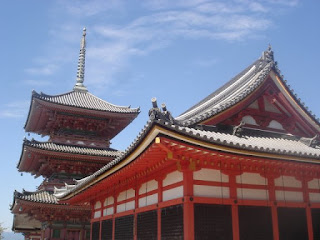
清水寺:Kiyomizudera. More than a thousand years ago a priest heard a prophecy telling him to build a temple near a stream of pure water. Pilgrims can come and drink this water even today.
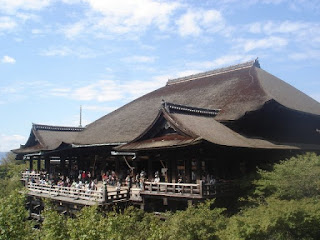
清水寺: Cultural heritage sites like Kiyomizudera are some of the last places in Japan to find thatch roofed buildings like this one. As you can see in the picture, this temple is rather crowded. Basically every important spot in Kyoto is overcrowded. Even to the Japanese this feels like one of the last places to see old Japan.
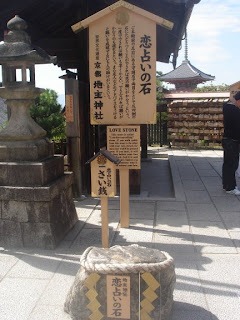
In a small Shrine next to Kiyomizudera you can find the "love rock". Anyone who can walk blindly along a short path to this rock and find the rock is promised swift good luck in romance. Anyone who tries and fails, however, is promised a lot of painful waiting.
The highlight of the weekend for me was this forest path. I wandered away from Kiyomizudera and the love rock shrine into some lovely scenery that was surprisingly completely vacant. The rustle and obnoxious chattering of the crowds faded and I could hear someone playing traditional Japanese flute in the distance. After a few minutes, however, someone from the group called me to see where I'd gone.
蓮華王院(三十三間堂): This temple's official name is Rengeoin, but it is more commonly known as Sanjusangendo (Hall with 33 spaces between the columns) The main hall is Japan's longest wooden structure and is home to a thousand life-sized statues of Kannon, the thousand-armed deity of compassion. It has also statues of nearly 30 other deities such as the gods of wind and thunder. The statues inside are all around 7-8 hundred years old. The influence of Hinduism comes across very clearly in the naming of the deities and the forms they take. Although Japan certainly gave its own twist to Indian-born Buddhism, of all the deities represented in this temple only the god of wind appeared to be originally Japanese. They don't allow photography inside, so, I took a picture of a couple girls from the group staring at their guidebooks instead.


I show all these photographs of temples, but the true story of Kyoto lies in the Philosopher's Path entry that I wrote shortly after the trip. Basically, I spent a weekend getting lost. Be it the 1 hour hunt for an Irish pub for fish and chips that should've taken only 15 minutes (only to arrive and find that England was playing in the rugby world cup that evening leaving no room for dining), or the elusive Philosopher's Path, we spent a lot of time just wandering aimlessly. The worst came after fish and chips. The Artist (he is an actual artist) pictured above, his wife and I, sad to be unable to eat fish and chips (after an hour of hunting one does tend to develop a craving) were lucky enough to happen upon a cafe near the pub that served fish and chips. We enjoyed our dinner, and then the two other girls with us came all the way across town to join us for the evening. Unfortunately, the evening was already getting late, and, apparently, all public transportation shuts down by midnight. This is something we discovered the hard way. As the girl nicknamed Mana quipped, "Kyoto is a city that never sleeps because everyone misses the train". Thus, we ventured 2 hours on foot to return to our hostel stopping by conbinis (convenience stores) along the way for fuel.

Some people go pub crawling. In Kyoto, we went conbini crawling.

京都: entertaining eccentricities

I've noticed lately how this blog has been in need of some of the finer silliness Japan has to offer. Here are a few examples from the Kyoto trip.
Unfortunately, the White Lover was not in need of any ethnically authentic help when we passed it.
So, we had to console ourselves with a rousing game of darts in another cafe.
The train station is a very modern complex with shops, restaurants, a stage for performance and space-age children at every entrance to greet travelers.
Colonel Sanders not only developed a world famous recipe for crispy chicken, he also was a grandmaster swordsman.

Monday, 8 October 2007

The Philosopher's Path: Haiku Round 1

I went to Kyoto (京都) over the weekend. It's only 1.5 hours by express train from Fukui city. Actually, though, I'm not going to write too much about Kyoto in this entry. This is more about something I discovered while wandering in between temples and shrines with friends from Fukui.

In between two temples in Kyoto there lies a scenic walkway known as the Philosopher's Path (哲学の道). I say this only because the maps and guidebooks mention it - not because I actually walked it. Yea though a friend and I spent an entire afternoon searching for the Philosopher's Path, we ne'er did find it. Corner after corner of turns and dead ends and false leads, but no scenic trail.

I mention the Philosopher's Path because the friend who led me into the meandering nonsense also led me into an awakening of what really has drawn me back to Japan:

The Broads!
Ahem, hello, Grandma. Yes, I came back to Japan to reunite with my Japanese supermodel girlfriend. She loves ice cream, robots and grandiose Hindi song and dance routines as much as I do. We plan to have 3 children and name them all after you.


Ha, actually, the awakening came through a book my Philosopher's Path Finding Partner pointed out to me in the English section of a bookstore in the downtown shopping area. The name of the book is おくのほそ道 (The Narrow Road to Oku) by 松尾芭蕉(Matsuo Basho). It's the account of 17'th century poet Basho on his long journey from his home to a place called Oku. Basho is most famous for his Haiku. Haiku are very simple 17 syllable poems that often evoke images of nature to create emotion. When I was first trying to teach myself bits of Japanese in high school, I used to trade Haiku back and forth with a friend whenever we were bored in class. I continued the haiku into university years, but, for some reason my subconscious has probably purposefully removed from my memory, I stopped.

The beauty in Haiku is simplicity. The poet has only 3 lines and 17 syllables to convey his message. This simplicity permeates many facets of Japanese culture and history. The Shinto faith, native to Japan, never developed scripture or even rules. Its practitioners have the fire and gold of autumn leaves and the blossoming cherry trees in spring to inspire them. Japanese cuisine has often avoided heavy seasoning and even cooking in order to preserve the natural flavor of food. What is perhaps the most famous poem in Japanese history is one of Basho's haiku: a simple ode to the sound of a frog jumping in water.

In rediscovering Haiku, I came to know some of my own motivation. It's been there for a long while, for certain, I just hadn't acknowledged it. What a joy it would be if we could toss aside ornamentation and small talk and simply allow the natural state of things to reveal itself!

Anyway, here's my attempt at rediscovering Haiku. This photograph is from 銀閣寺 (The Silver Pavilion) in Kyoto. The Philosopher's Path is allegedly near here.
Raked sands and dead ends
Form the philosopher's path
But wiser men nap


And another about my frustration at slamming into a wall of hikers nearing the peak of Fuji in August:
Queuing for sunrise
Nothing moves, so I pray that
Lava melts tourists