"You can forget your lunch but never your umbrella." ~A Fukui saying
Showing posts with label 景色(Scenery). Show all posts

Saturday, 24 September 2011

小京都革命: Revolution in Little Kyoto

サイクリングは趣味で、たまに福井市の近くの「小京都」で呼ばれる大野市へ行く。日本にいくつかの「小京都」はあると思うけど、大野市は自分の気に入りの田舎のお出掛けだ。自転車で山や田んぼを眺めながら落ち着く。

One of my hobbies is cycling, and I sometimes like to go to a town near Fukui City called Ono, which is also sometimes called "Little Kyoto" (Its temples and traditions are reminiscent of Kyoto according to some people). I think there are any number of "Little Kyoto" towns in Japan, but Ono is a personal favorite countryside getaway for me. Admiring the mountains and fields from a bicycle is very calming.

長年大野に住んでいる外国から来た友達は普通あまり町を出ないけど今年のお盆休みに仲間が一人も大野にいなかった。ということは、小京都は無防備になった。戦争戦略ゲームが好きな俺様はこんな機会を絶対に逃さないから、すぐ旅の準備をして大野を征服しに行った。
国、町等を征服するには旗が必要だからそれを準備した。下の写真は俺様の栄光の勝利の証拠だ。

Friends of mine from overseas who have lived in Ono for a long time usually don't leave town much, but this year during vacation time in August not one person remained there. This means that Little Kyoto was left defenseless. As a fan of war strategy games, I simply could not pass up this opportunity. I quickly prepared for my journey and set out to conquer Ono.
When conquering a country or a town, flags are necessary, so I prepared one. The pictures below are evidence of my glorious victory.

小京都は俺様のものじゃ!

これから大野に行く時ここで泊まる。
From now on when I visit Ono, I'm staying here.

俺様のお清水
My pure spring water

俺様の国際的に有名な半熟味付け煮玉子(越前大野駅の近くのラーメン屋さん)
My internationally renowned seasoned soft-boiled eggs (from a ramen place near the Ono JR station)

この寺町の写真をよく見たら、征服の道具が見える。
If you look closely at this picture of the temple district, you can see the instrument of my conquest.

俺様の里芋。
My satoimo fields.

俺様の山。俺様のお米。
My mountains. My rice.

俺様の不思議な橋。
My mysterious bridge.

俺様の置き忘れられた建設機器。
My misplaced construction equipment.

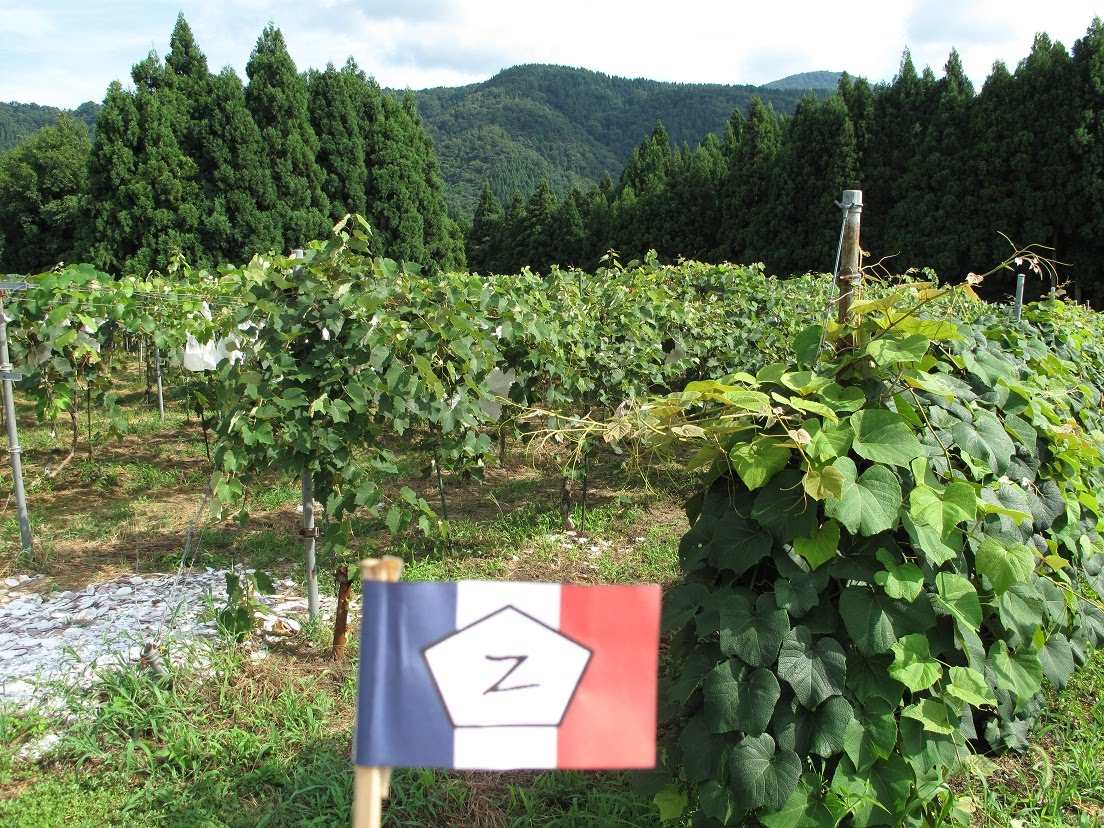
忙しい一日を終えて、この山葡萄で出来たワインを飲んでリラックスした。
After a hard day, I relaxed with wine made from these mountain grapes.

新しい帝王を祝う花火。
Fireworks to celebrate the new sovereign.

Sunday, 16 January 2011

2 AM This Morning

It snowed a lot last night. This is the view from my flat at 2 AM.
This is what things looked like in the morning.
This is what I was looking at a little more than a week ago. I'll post more about that later.

Monday, 26 October 2009

Cycling Scenery: Winery Visit

A few weeks ago I spent a day cycling trying to find a winery I saw advertised while on a previous ride. The picture below illustrates what most of the countryside looks like out in the hills where I was wandering.
I did eventually find the place: Hakusan Winery. Wine really has no tradition in Japan, and this particular location has only been in operation for less than 10 years. Basically, they grow a few grapes in the hillside. Not much to look at, but still I had a nice afternoon ride, nonetheless.
Not much else to report. If weather allows, I'll be going back to this same area this weekend to do some hiking with an elderly couple that are friends with my Japanese instructor. I've never met them before. Should be interesting.

One last thing, a friend of mine wasn't updating her blog, so I did it for her. You probably don't know her unless if you live in Fukui, but, anyway, if you're curious, here's a link: friendblog

Sunday, 18 January 2009

Taroko Gorge: Formosa Entry #2

Here are some more pictures from the national park I mentioned in the previous entry.

This is the inside of the pagoda that you can see in the background of the temple picture in the first entry.

And here's the view from the top of the pagoda. A sign at the temple said that the Buddha statue holds a world record for being at the highest altitude of any Buddhist statue of that type.

Saturday, 10 January 2009

我們都是一家人: Formosa Entry #1

The holidays are over, and now I'll be posting about Taiwan over the next couple weeks.
I could introduce my venture with information about the island, but I decided instead to begin with the story of my first couple days.

I've been on many good trips by myself. I often find the solitude and freedom of traveling alone to be preferable to having to suffer the whims and whimpering of a group. With that being said, I also find that when you leave yourself open to adaptation and accept situations as they come, you never really travel alone. This trip is, perhaps, the best example of that to come from my experience.

The overall impression I had throughout my time in Taiwan was that someone had been waiting for me to arrive. Rather than a first trip, it felt like the island was greeting me with a hug and saying, "Welcome back. We've missed you."

Frankly, it caught me off guard.
Anyway, on to the first couple days (I insert spur of the moment thoughts in italics).

Remember, you can click on the pictures to view them in a larger format.
I arrived in Taipei in late afternoon, spent the night in a cheap hostel with no windows or shower curtains and skipped out early in the morning for the East Coast city of Hualien. Hualien is known to tourists mostly as the starting point for trips into Taroko National Park, a cascade of mountains and marble cliffs surrounding a highway that runs along a river gorge (these pictures). The park has also been home to a few of Taiwan's dwindling indigenous groups, some of whom were headhunters until the Japanese colonial government outlawed the practice less than one hundred years ago.

That afternoon I walked along the shoreline and tasted various delicacies on sticks at street markets. When I returned to my hostel I met my two roommates for the evening, an engineer from Singapore and a Guatemalan graduate student who is currently living near Tokyo. The next morning the three of us set out for Taroko.
The advantage to tagging along with someone from Singapore while in Taiwan is that Mandarin is an official language in both places. The night before our trek into the national park he was of great help in our trio's quest to sample food from every vendor that the hostel recommended.

At 06h30 we took the first bus up the gorge highway and began our day in Taroko. There's not much to say about hiking along the highway and side trails except that the scenery is wonderful and public transportation is hard to find. Sure, there are group tours you can take, but then you have to deal with group tourists.


After trekking at least 20 km (13 miles), we found ourselves tired and unsure of where the local buses would stop. We decided to try to hitch a ride to the nearest bus stop. After several cars passed us over the lad from Singapore reassured us saying, "Whatever you believe in just have faith. It'll work out."
Yeah, sure, who wouldn't want to pick up three strangers while driving in the mountains far away from the city?
Taiwan did not seem to understand my mind's intrinsic need for sarcasm and cynicism.

Shortly after my Chinese-speaking comrade's religious appeal someone did, indeed, stop to give us a lift. A woman, her husband and a friend pulled over, and, in the course of highway conversation, revealed that not only did they normally not pick up hitchhikers, but they also had passed over someone along the road just before finding us.


"This is fate," said the lady at the wheel, "we were supposed to meet each other."
Arrrgh, cynic senses are tingling. People just don't talk like this unless if...oh, no...it can't be!
I'm surrounded by Buddhist missionaries!

As it turns out, only the driver was actually a Buddhist missionary, and, technically she wasn't so much a missionary as a volunteer for a Buddhist charity organization that builds hospitals and schools around the world. Her husband, we soon realized was actually a Japanese man who spoke no Mandarin. They normally reside in Japan but had recently purchased a house in her hometown of Hualien and were vacationing for a few months.

She offered us the chance to stay at her place for the same cost as the hostel and promised to donate all the money to her charity. Although I had planned to return to the Taipei that evening, I altered my schedule to allow for a Hualien homestay.

That night, as we were sitting around chatting in a mix of English, Japanese and Mandarin, our generous host taught me the expression written above,

我們都是一家人: "we're all like one family"
This is nice, but, c'mon, you can't talk like that to people you've only just met. Can you?

The next day she drove us all over Hualien introducing us to snacks, drinks and scenery we would've been want to find on our own.


Having lived in Japan for a couple years, my standard expectations for polite friendliness to guests is rather high. I had read that Taiwan was one of the most welcoming places on Earth, but, given my experience in Japan, I figured I was prepared for it. Even so, my first couple days left me completely disarmed. As I sat on the train for Taipei after my time in Hualien I found myself shaking my head in disbelief
.
This level of hospitality just can't exist, and, yet, in spite of everything evil in the news today, it does. Could there still be a few people out there worth believing in?

Monday, 27 October 2008

October School Life

Remember a while back when I said I was going hiking at one of Japan's 3 holy mountains? I have some pictures from that trip ready to post, but I'm just not getting around to it yet.

Instead, here are some school related pictures. Last Friday I went along with the first year students on a trip to the nearby city of Katsuyama to visit a temple/shrine called Heisenji, a castle museum (castle built in the last 20 years or so) and the Fukui Dinosaur Museum (only dinosaur museum in Japan)
It was raining that day, but I really liked what the rain did for the atmosphere at Heisenji.These two pictures here are mobile phone photographs of an art project the entire school made today with the help of a famous local artist. We took big rice bags and wrote wishes, wants and desires on them. Then, we turned the bags inside-out and piled them together to make this particular art thing.
Some people wished for peace, prosperous future careers, happiness for friends, etc. As for me, my wish was in French, and that's all I'm willing to say about it public
And, finally, a Halloween greeting from your friends at the Fukui Prefectural Dinosaur Museum.


Speaking of Halloween, I finished the costume with a little help from a friend on the trousers, and really had a go of things this weekend at a Halloween Party that honestly was much to crowded and poorly lit for my tastes (left really early) and the International Festival at the International Center (much better lighting and atmosphere so I stayed all day for that one).

Abu really hit it off with the ladies and left me alone for a while to fend for myself with a sometimes violent little girl desperate to prove to herself whether or not I was the real Aladdin, but, save for some minor shin abrasions, the day was fun. My Fukui host family was there in the morning, and Abu really got on well with the little boy.
So, what I've learned this weekend is that if I want to get people to like me, all I really need to do is be more like a monkey.

Thursday, 2 October 2008

New Season Old Pictures

You may have noticed a change in the picture atop the page. I've decided to make that seasonal. Yes, I know, Han Solo and Princess Leia being swallowed by a squid snack doesn't bring up memories of hot cider, jack 'o' lanterns and hay rides, but it reminds me of a fall 3 years ago when I first came to Japan.

I've considered making a separate page someday just for pictures of Han and Leia and their travels. I'll wait and see what the adoring public thinks about that. Speaking of the "public" that reads this, how are you doing, Grandma?If you read the previous entry, you'd have noticed that I mentioned working at a junior high school instead of a high school. That's because I changed schools after summer break. Essentially, I have become Fuji Climbing Partner (took over her job).

I now work at an academic middle school 3 days a week and a non-traditional high school 2 days a week. The middle school feeds students into the more academic high schools (there's an entrance exam for high school and university in Japan) which feed students into universities. The high school is the polar opposite of the environment in the middle school since it was designed for students who couldn't make it in a normal setting. One is academic, busy and filled with high expectations and stress, and the other is relaxed, slow-paced and not even filled at all (class sizes range from 1-20 students). So far, I really like both schools.

I'm feeling really confident this time around. The schools are new, but the work and location aren't new. I'm feeling more and more comfortable here, and learning some useful Japanese in preparation for a big proficiency test in December. I don't know my chances of passing the test, but, at least, I'm learning.

So, what are these random pictures?

The one right above with all the orange is from a shrine in the hillsides in Kyoto. I went on a final big outing to Kyoto with a few of my closest friends in June. Future Wife, Fuji Climbing Partner, The Artist and his Wife. All names that won't be appearing much anymore. This particular shrine is famous for its hundreds of Tori (the orange shrine gates) that wind all around a pathway into the hills.

The two mountain photographs are from near the city of Ono in Fukui prefecture. I went hiking with some friends late in the spring. Everything was perfectly clear on the way up, but then a couple people (Kanji Fiend & company) had to complain about how clouds always blur the peaks of mountains when they go hiking, and, lo and behold, the way back down the mountain turned out just like they expected.If all goes as planned, this weekend I'll go hiking again. This time, I'm going after Tateyama, one of Japan's three holy mountains. The other two are Fuji and Hakusan. Hakusan is actually located here in Fukui Prefecture, but I haven't had the chance to go yet.

Thursday, 8 May 2008

More Kobe Area Photographs

Now, time to post a few more pictures from my spring holiday in Kansai (the region with Kobe, Osaka and Kyoto). I should have posted these a month ago, but, well, springtime makes me feel lazy.These first few are of the temple grounds of Engyouji. Engyouji is a mountain temple complex near Himeiji Castle (pictured in the "Sadness of Spring" entry). While Himeiji is a popular tourist spot with crowds year-round, Engyouji's semi-remote terrain makes for a nice escape from the crowds. Travelers can reach the grounds via a somewhat pricey tram, or they can hike for an hour or so (provided they can find the trail). I rode the tram up and hiked down.
Engyouji's claim to fame, besides its centuries old history and beautiful mountain scenery, is its use in the film The Last Samurai. I think most of the film was shot in New Zealand given that the ubiquitous power lines and concrete embankments in Japan make it really difficult to find any place that still looks completely natural, but a few scenes actually were truly Japanese.
Engyouji has a few trails leading around the mountain. It takes a decent bit of walking to see all of it.
Finally, a bit of splendid news. On my return to Fukui, I decided to spend a day in Kyoto admiring the sakura, since Kyoto is in between Kobe and Fukui. While there, I managed to do something by myself that a friend and I only daydreamed of achieving together last fall. I found the Philosopher's Path!

For a recap of why this is significant, look back at one of my entries I wrote after my first trip to Kyoto in October. Here
Yea, though we did wander many a good hour, our efforts were in vain as the Philosopher's Path refused to show itself. This time around, large swaths of flower viewers and large markings labeled "Philosopher's Path This Way --->" made the journey all the easier.

Now, all I have to do is discover the Umeda Sky Building in Osaka and my list of painfully easy to find popular Japanese tourist destinations that have thus far eluded me will be restored to zero.

Wednesday, 9 April 2008

The Sadness of Spring

If you come to recognize no other kanji (Chinese character) that I've ever written on this blog, at least get to know this one:
:sakura (cherry blossom)
Last week the cherry blossoms began blooming across Japan. I took the above picture at Himeiji castle, near Kobe. The blooming of the cherry blossom is, perhaps, the most important natural phenomenon to occur in Japan. Sakura is a proud cultural symbol that figures prominently in music, literature and artwork. Newspapers and newscasts give predictions of when the blooming should begin in various parts of the country, and people step out in droves to delight in the newfound springtime beauty.
花見: hanami (flower viewing)
A group of tourists enjoy hanami along a river in Kyoto.

The arrival of sakura marks the end to the long, cold, wet, miserable winter season. As one of the most easily recognizable symbols of Japan, it brings much happiness with its beauty, but also a tinge of sadness. The blooms only linger a couple weeks. Thus, although their arrival is a joyous occasion, those who view them do so understanding the oft clichéd phrase that all good things


must end someday.

Sunday, 30 March 2008

白川郷: Shirakawago

A few days after the festival in Nagoya, a friend and I ventured into the mountains to experience a taste of traditional village life. Nestled in a valley in Gifu Prefecture, next to Fukui, lies Shirakawago - a collection of thatched roofed houses that have been declared a World Cultural Heritage Site by the United Nations.
Although Fukui was warming to nice spring temperatures, the mountain village still had snow and a chill in the air. There isn't much to say about the village except that it's quiet, peaceful and scenic. People who live there seem to enjoy tending to tourists' needs, managing agriculture and owning dogs. Really not a lot to do in the area for anyone with an itch for livin' la vida loca.We stayed the night in one of the houses. this is the main room where we ate. The fire pit in the middle is the traditional means of heating houses and cooking meals. We used an electric space heater in our room. Although the village experience may not sound very exciting, it was a great escape. Day after day going to a job with no work was wearing on my nerves, and the hot bath and quiet evening away re-energized me just in time to take on spring break.

Saturday, 23 February 2008

地獄谷: Hell Valley

Just look for the demons along the highway south of Sapporo to find your way into an area known as Hell Valley.
It's earned its nickname from the naturally boiling sulphuric ponds nestled in the mountains. Volcanic activity is responsible for the steam rising from the snowy hills you see in the picture below. The gases released in said activity also give the area the distinct aroma of a log cabin in Northern Wisconsin full of deer hunters shortly after Thanksgiving dinner.
In spite of the smell, the neighboring town of Noboribetsu (登別) is a bustling vacation spot for those interested in spas and hot baths.
While walking the pathways of Hell, I couldn't help but notice all the snow and ice around me calling back to all those times someone has said, "it'll be a cold day in hell before I go out with you," or "sure, I'll give up my serious relationship with Ian and marry you just as soon as Hell freezes over!"
Ahem, looks like fate has dealt me a fair hand in this one.
For all the talk of volcanic activity, however, anyone with the patience to wait until just before sundown, when all colors fade into a blue-ish gray, will see the real cause of the mix of snow and heat.

Sunday, 13 January 2008

Winter Holiday 3: Koh Chang

On the evening of Christmas Day we landed on Koh Chang ("Elephant Island"), the second largest island in Thailand. The tropical foliage, laid back atmosphere and warm water made for the most relaxing days I've experienced since leaving for Japan, yet, somehow something didn't feel right. As I gazed through the palm trees into the emerald horizon the very first thought to enter my mind was,
"Kumquat. Was kumquat, perhaps, my favorite bubble tea flavor back at the Great Wall in Bloomington? What on earth am I doing in Thailand right now?"

Yes, beautiful tropical island. blah blah blah. Perhaps ten years ago it was a virgin rain forest paradise escape, but today Koh Chang (& the rest of Thailand for that matter) has many of the same problems as the United States.
And they're all fat white men.
As you can see here, Koh Chang is a true escape from modernity. The island also now features more than a dozen golf courses. Who needs a rain forest when you could have thousands of pudgy European men bringing piles and piles of fresh Euros and Pounds to spend on a relaxing weekend with their new Thai girlfriends?
Tourist catered destruction aside, the scenery is lovely. German Speaker and Infectious Laughter both seemed really touched by the sunset. I've seen my share of sunsets and, although less vocal about it all, still ended up spending most of the night this picture was taken sitting on a rock watching the form of the star change slightly at the point it met with the water's edge.

In Le Petit Prince at some point it says that people really enjoy sunsets when they're sad. Maybe we were sad for the island that night. As for me, I think I was lonely for bubble tea.
Another example of the island's authentic spirit. A North American First Nations themed Swedish restaurant!

Sunday, 21 October 2007

京都:Kyoto

All right, I understand this is late, but, anyway, I have a few pictures from my trip to Kyoto a few weeks ago to share.
Kyoto was Japan's capital for about a thousand years until the 17'th century when the Shogun Tokugawa moved the military government to Edo (modern day Tokyo). The Imperial family remained in Kyoto during this period but moved to Tokyo in the mid-19'th century as the country began reforming and opening to international influences. Because of its historical importance and many cultural heritage sites it was spared from the US bombardments during WWII that destroyed many other cities. Unfortunately, in an effort to be more "modern" like the Western nations that won the war, the Japanese went on to destroy much of the traditional architecture in the city on their own. What was once one of the most beautiful, skylines in the country is now a mesh of ugly buildings that resemble nothing Western or Japanese. Still, a few decent spots remain.
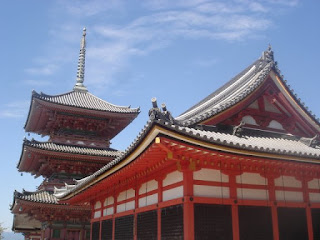
清水寺:Kiyomizudera. More than a thousand years ago a priest heard a prophecy telling him to build a temple near a stream of pure water. Pilgrims can come and drink this water even today.
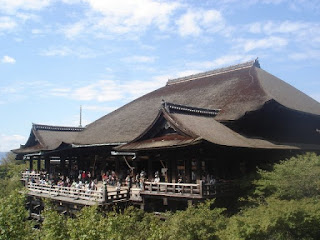
清水寺: Cultural heritage sites like Kiyomizudera are some of the last places in Japan to find thatch roofed buildings like this one. As you can see in the picture, this temple is rather crowded. Basically every important spot in Kyoto is overcrowded. Even to the Japanese this feels like one of the last places to see old Japan.
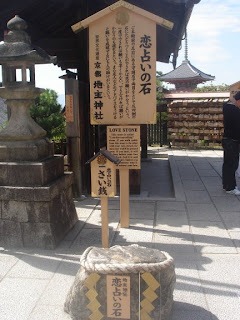
In a small Shrine next to Kiyomizudera you can find the "love rock". Anyone who can walk blindly along a short path to this rock and find the rock is promised swift good luck in romance. Anyone who tries and fails, however, is promised a lot of painful waiting.
The highlight of the weekend for me was this forest path. I wandered away from Kiyomizudera and the love rock shrine into some lovely scenery that was surprisingly completely vacant. The rustle and obnoxious chattering of the crowds faded and I could hear someone playing traditional Japanese flute in the distance. After a few minutes, however, someone from the group called me to see where I'd gone.
蓮華王院(三十三間堂): This temple's official name is Rengeoin, but it is more commonly known as Sanjusangendo (Hall with 33 spaces between the columns) The main hall is Japan's longest wooden structure and is home to a thousand life-sized statues of Kannon, the thousand-armed deity of compassion. It has also statues of nearly 30 other deities such as the gods of wind and thunder. The statues inside are all around 7-8 hundred years old. The influence of Hinduism comes across very clearly in the naming of the deities and the forms they take. Although Japan certainly gave its own twist to Indian-born Buddhism, of all the deities represented in this temple only the god of wind appeared to be originally Japanese. They don't allow photography inside, so, I took a picture of a couple girls from the group staring at their guidebooks instead.


I show all these photographs of temples, but the true story of Kyoto lies in the Philosopher's Path entry that I wrote shortly after the trip. Basically, I spent a weekend getting lost. Be it the 1 hour hunt for an Irish pub for fish and chips that should've taken only 15 minutes (only to arrive and find that England was playing in the rugby world cup that evening leaving no room for dining), or the elusive Philosopher's Path, we spent a lot of time just wandering aimlessly. The worst came after fish and chips. The Artist (he is an actual artist) pictured above, his wife and I, sad to be unable to eat fish and chips (after an hour of hunting one does tend to develop a craving) were lucky enough to happen upon a cafe near the pub that served fish and chips. We enjoyed our dinner, and then the two other girls with us came all the way across town to join us for the evening. Unfortunately, the evening was already getting late, and, apparently, all public transportation shuts down by midnight. This is something we discovered the hard way. As the girl nicknamed Mana quipped, "Kyoto is a city that never sleeps because everyone misses the train". Thus, we ventured 2 hours on foot to return to our hostel stopping by conbinis (convenience stores) along the way for fuel.

Some people go pub crawling. In Kyoto, we went conbini crawling.