"You can forget your lunch but never your umbrella." ~A Fukui saying
Showing posts with label 神社(Shrines). Show all posts

Thursday, 12 February 2009

Setsubun, Risshin & Formatting Updates

Greetings all!
Sorry I haven't updated in a couple weeks. I've still got some things to share from my experience in Taiwan, and I recently spent the evening at Eiheiji learning zazen (meditation).

In the meantime, I've made some changes to the format of this blog. You'll notice along the left hand side that links to other blogs have changed, and you now can see a list of labels. I added that for easy archiving purposes. Now, if you want to see anything I've written about something like temples or festivals, all you have to do is click on the label for temples or festivals. I also inserted a translation service at the bottom of the page.

While looking through the archives I noticed that some pictures seemed to have disappeared. I checked my storage limit, and I really don't know why this has happened. While looking up the storage limit, however, I found out that all the pictures I post here automatically get sent to an online photo storage service. If I ever organize that, I'll post a link.

Now, on to some updates:

This is a photograph I took in January shortly after returning from my travels. We had a decent amount of snow for probably less than two weeks in Fukui City. Then, it warmed up just enough to change to rain, and all the snow disappeared.

I noticed something with the snowfall this year that I don't recall from last year - THUNDER. Turns out that Western Japan is one of three places in the world where it can thunder while snowing.
February 3rd was setsubun this year. (click here for old post on setsubun). It's the end of winter on the lunar calendar, and people celebrate by tossing beans to ward off demons. I decided to check out events at a local shrine but heard the wrong starting time and showed up just as it ended.The day after setsubun is called risshin. This is the first day of spring on the lunar calendar. I believe it snowed on this day last year.

Monday, 27 October 2008

October School Life

Remember a while back when I said I was going hiking at one of Japan's 3 holy mountains? I have some pictures from that trip ready to post, but I'm just not getting around to it yet.

Instead, here are some school related pictures. Last Friday I went along with the first year students on a trip to the nearby city of Katsuyama to visit a temple/shrine called Heisenji, a castle museum (castle built in the last 20 years or so) and the Fukui Dinosaur Museum (only dinosaur museum in Japan)
It was raining that day, but I really liked what the rain did for the atmosphere at Heisenji.These two pictures here are mobile phone photographs of an art project the entire school made today with the help of a famous local artist. We took big rice bags and wrote wishes, wants and desires on them. Then, we turned the bags inside-out and piled them together to make this particular art thing.
Some people wished for peace, prosperous future careers, happiness for friends, etc. As for me, my wish was in French, and that's all I'm willing to say about it public
And, finally, a Halloween greeting from your friends at the Fukui Prefectural Dinosaur Museum.


Speaking of Halloween, I finished the costume with a little help from a friend on the trousers, and really had a go of things this weekend at a Halloween Party that honestly was much to crowded and poorly lit for my tastes (left really early) and the International Festival at the International Center (much better lighting and atmosphere so I stayed all day for that one).

Abu really hit it off with the ladies and left me alone for a while to fend for myself with a sometimes violent little girl desperate to prove to herself whether or not I was the real Aladdin, but, save for some minor shin abrasions, the day was fun. My Fukui host family was there in the morning, and Abu really got on well with the little boy.
So, what I've learned this weekend is that if I want to get people to like me, all I really need to do is be more like a monkey.

Thursday, 2 October 2008

New Season Old Pictures

You may have noticed a change in the picture atop the page. I've decided to make that seasonal. Yes, I know, Han Solo and Princess Leia being swallowed by a squid snack doesn't bring up memories of hot cider, jack 'o' lanterns and hay rides, but it reminds me of a fall 3 years ago when I first came to Japan.

I've considered making a separate page someday just for pictures of Han and Leia and their travels. I'll wait and see what the adoring public thinks about that. Speaking of the "public" that reads this, how are you doing, Grandma?If you read the previous entry, you'd have noticed that I mentioned working at a junior high school instead of a high school. That's because I changed schools after summer break. Essentially, I have become Fuji Climbing Partner (took over her job).

I now work at an academic middle school 3 days a week and a non-traditional high school 2 days a week. The middle school feeds students into the more academic high schools (there's an entrance exam for high school and university in Japan) which feed students into universities. The high school is the polar opposite of the environment in the middle school since it was designed for students who couldn't make it in a normal setting. One is academic, busy and filled with high expectations and stress, and the other is relaxed, slow-paced and not even filled at all (class sizes range from 1-20 students). So far, I really like both schools.

I'm feeling really confident this time around. The schools are new, but the work and location aren't new. I'm feeling more and more comfortable here, and learning some useful Japanese in preparation for a big proficiency test in December. I don't know my chances of passing the test, but, at least, I'm learning.

So, what are these random pictures?

The one right above with all the orange is from a shrine in the hillsides in Kyoto. I went on a final big outing to Kyoto with a few of my closest friends in June. Future Wife, Fuji Climbing Partner, The Artist and his Wife. All names that won't be appearing much anymore. This particular shrine is famous for its hundreds of Tori (the orange shrine gates) that wind all around a pathway into the hills.

The two mountain photographs are from near the city of Ono in Fukui prefecture. I went hiking with some friends late in the spring. Everything was perfectly clear on the way up, but then a couple people (Kanji Fiend & company) had to complain about how clouds always blur the peaks of mountains when they go hiking, and, lo and behold, the way back down the mountain turned out just like they expected.If all goes as planned, this weekend I'll go hiking again. This time, I'm going after Tateyama, one of Japan's three holy mountains. The other two are Fuji and Hakusan. Hakusan is actually located here in Fukui Prefecture, but I haven't had the chance to go yet.

Saturday, 5 April 2008

梅花: Plum Blossom

While driving back from Sumo in Osaka, my entourage and I stopped at a shrine on Lake Biwa, Japan's largest lake. I thought I'd share a few of the pictures.
The plum blossoms had just begun to bloom. That's a tori, the name for a shrine gate, in the background.
The highway splits two of the tori.
Here, the two passengers of my car (oh, yeah, got a car in March - will show a picture sometime soon) sit and admire the tori. Look closely and you'll notice that it's in the lake itself.

Haven't quite given these two nicknames yet. Let's see, the guy on the left is in my calligraphy class and well-versed in various Chinese characters, so I'll call him Kanji Fiend. The girl on the right just started driving after coming to Japan and nearly killed me in October, so I'll call her New Driver.

Thursday, 27 March 2008

NOT SAFE FOR CHILDREN festival

A few weeks ago, my favorite little former host sister from Nagoya turned 10. Conveniently, many girls here in Fukui really wanted to go to Nagoya the weekend of her birthday, so it wasn't hard to fill a car with people for the journey over. The Fukui girls, however, had no idea any birthdays were taking place. They had an ulterior motive: a 2 meter long, wooden ulterior motive.

WARNING: the pictures in this entry probably aren't so great to show the kids (even though many children were at this festival)Every year in spring a couple of shrines in Nagoya host festivals in celebration of fertility just in time for spring planting. One festival takes on a female theme and the other has a male theme. The male themed festival draws in the largest crowd, including the most packed group of foreigners I have ever seen in Japan (what does this say about the collective maturity of we non-Japanese residents, I wonder?)
There is food (pictured above) to match the theme, and a small parade. During the parade, people marching hand out many cups of free sake to onlookers and encourage some good luck pats on various wooden "structures".
The festival ends when the "structure" enters the shrine at the end of the parade. At the end of it all, the Western onlooker can't help but laugh at the large gathering of pale skinned persons and lament the great shame we've been taught to render our own bodies. Would this festival be so intriguing to us if we didn't deem it so naughty? The Japanese don't seem to find much offensive about it.
Now, to make up for the strange pictures above, I've added a nice sunset photograph from the Oasis structure in the Sakae district of Nagoya.

Sunday, 21 October 2007

京都:Kyoto

All right, I understand this is late, but, anyway, I have a few pictures from my trip to Kyoto a few weeks ago to share.
Kyoto was Japan's capital for about a thousand years until the 17'th century when the Shogun Tokugawa moved the military government to Edo (modern day Tokyo). The Imperial family remained in Kyoto during this period but moved to Tokyo in the mid-19'th century as the country began reforming and opening to international influences. Because of its historical importance and many cultural heritage sites it was spared from the US bombardments during WWII that destroyed many other cities. Unfortunately, in an effort to be more "modern" like the Western nations that won the war, the Japanese went on to destroy much of the traditional architecture in the city on their own. What was once one of the most beautiful, skylines in the country is now a mesh of ugly buildings that resemble nothing Western or Japanese. Still, a few decent spots remain.
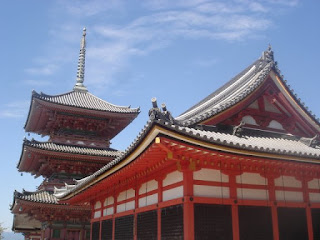
清水寺:Kiyomizudera. More than a thousand years ago a priest heard a prophecy telling him to build a temple near a stream of pure water. Pilgrims can come and drink this water even today.
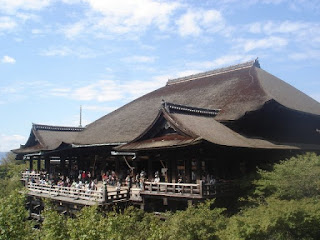
清水寺: Cultural heritage sites like Kiyomizudera are some of the last places in Japan to find thatch roofed buildings like this one. As you can see in the picture, this temple is rather crowded. Basically every important spot in Kyoto is overcrowded. Even to the Japanese this feels like one of the last places to see old Japan.
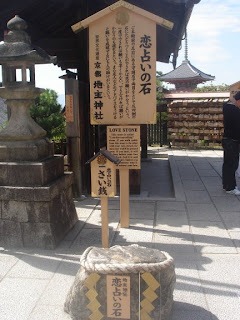
In a small Shrine next to Kiyomizudera you can find the "love rock". Anyone who can walk blindly along a short path to this rock and find the rock is promised swift good luck in romance. Anyone who tries and fails, however, is promised a lot of painful waiting.
The highlight of the weekend for me was this forest path. I wandered away from Kiyomizudera and the love rock shrine into some lovely scenery that was surprisingly completely vacant. The rustle and obnoxious chattering of the crowds faded and I could hear someone playing traditional Japanese flute in the distance. After a few minutes, however, someone from the group called me to see where I'd gone.
蓮華王院(三十三間堂): This temple's official name is Rengeoin, but it is more commonly known as Sanjusangendo (Hall with 33 spaces between the columns) The main hall is Japan's longest wooden structure and is home to a thousand life-sized statues of Kannon, the thousand-armed deity of compassion. It has also statues of nearly 30 other deities such as the gods of wind and thunder. The statues inside are all around 7-8 hundred years old. The influence of Hinduism comes across very clearly in the naming of the deities and the forms they take. Although Japan certainly gave its own twist to Indian-born Buddhism, of all the deities represented in this temple only the god of wind appeared to be originally Japanese. They don't allow photography inside, so, I took a picture of a couple girls from the group staring at their guidebooks instead.


I show all these photographs of temples, but the true story of Kyoto lies in the Philosopher's Path entry that I wrote shortly after the trip. Basically, I spent a weekend getting lost. Be it the 1 hour hunt for an Irish pub for fish and chips that should've taken only 15 minutes (only to arrive and find that England was playing in the rugby world cup that evening leaving no room for dining), or the elusive Philosopher's Path, we spent a lot of time just wandering aimlessly. The worst came after fish and chips. The Artist (he is an actual artist) pictured above, his wife and I, sad to be unable to eat fish and chips (after an hour of hunting one does tend to develop a craving) were lucky enough to happen upon a cafe near the pub that served fish and chips. We enjoyed our dinner, and then the two other girls with us came all the way across town to join us for the evening. Unfortunately, the evening was already getting late, and, apparently, all public transportation shuts down by midnight. This is something we discovered the hard way. As the girl nicknamed Mana quipped, "Kyoto is a city that never sleeps because everyone misses the train". Thus, we ventured 2 hours on foot to return to our hostel stopping by conbinis (convenience stores) along the way for fuel.

Some people go pub crawling. In Kyoto, we went conbini crawling.