"You can forget your lunch but never your umbrella." ~A Fukui saying
Showing posts with label Japanese(日本語). Show all posts

Saturday, 24 September 2011

小京都革命: Revolution in Little Kyoto

サイクリングは趣味で、たまに福井市の近くの「小京都」で呼ばれる大野市へ行く。日本にいくつかの「小京都」はあると思うけど、大野市は自分の気に入りの田舎のお出掛けだ。自転車で山や田んぼを眺めながら落ち着く。

One of my hobbies is cycling, and I sometimes like to go to a town near Fukui City called Ono, which is also sometimes called "Little Kyoto" (Its temples and traditions are reminiscent of Kyoto according to some people). I think there are any number of "Little Kyoto" towns in Japan, but Ono is a personal favorite countryside getaway for me. Admiring the mountains and fields from a bicycle is very calming.

長年大野に住んでいる外国から来た友達は普通あまり町を出ないけど今年のお盆休みに仲間が一人も大野にいなかった。ということは、小京都は無防備になった。戦争戦略ゲームが好きな俺様はこんな機会を絶対に逃さないから、すぐ旅の準備をして大野を征服しに行った。
国、町等を征服するには旗が必要だからそれを準備した。下の写真は俺様の栄光の勝利の証拠だ。

Friends of mine from overseas who have lived in Ono for a long time usually don't leave town much, but this year during vacation time in August not one person remained there. This means that Little Kyoto was left defenseless. As a fan of war strategy games, I simply could not pass up this opportunity. I quickly prepared for my journey and set out to conquer Ono.
When conquering a country or a town, flags are necessary, so I prepared one. The pictures below are evidence of my glorious victory.

小京都は俺様のものじゃ!

これから大野に行く時ここで泊まる。
From now on when I visit Ono, I'm staying here.

俺様のお清水
My pure spring water

俺様の国際的に有名な半熟味付け煮玉子(越前大野駅の近くのラーメン屋さん)
My internationally renowned seasoned soft-boiled eggs (from a ramen place near the Ono JR station)

この寺町の写真をよく見たら、征服の道具が見える。
If you look closely at this picture of the temple district, you can see the instrument of my conquest.

俺様の里芋。
My satoimo fields.

俺様の山。俺様のお米。
My mountains. My rice.

俺様の不思議な橋。
My mysterious bridge.

俺様の置き忘れられた建設機器。
My misplaced construction equipment.

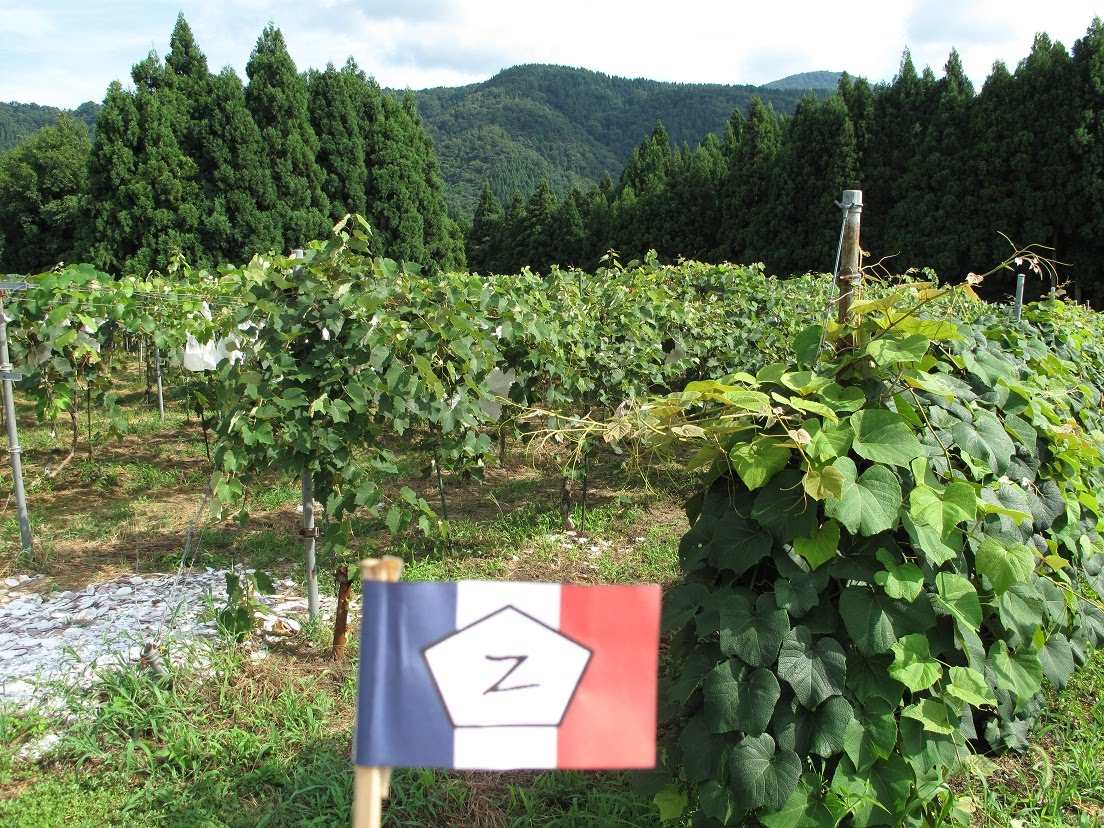
忙しい一日を終えて、この山葡萄で出来たワインを飲んでリラックスした。
After a hard day, I relaxed with wine made from these mountain grapes.

新しい帝王を祝う花火。
Fireworks to celebrate the new sovereign.

Friday, 29 October 2010

「嵐からの隠れ場所」: Real Men Don't Wear Skinny Jeans

(今回ハイパーリンクをたくさん入れた。楽しんでね)


中学校で働く。
中学生の時代は人生の中のとても面白いところだ。
一年生は元気いっぱいで、授業は大体楽しい。
二年生は自分の役割を探していて、まじめな勉強と幼い遊びの間にいる。
三年生は少しまじめ過ぎるけど、毎年三年生の中に知性か好奇心の輝きがある生徒を見つける。

面白いことは面白いんだが、ちょっと困るところもある。
I HATE ARASHI.
言っちゃった。
僕は高校時代から音楽に興味を持っている。
その「興味」に普通の女性より化粧するガリガリに痩せた男子のグループは一つも含まれてない。
ロック、ジャズ、クラシック、オペラでも聴くけど、中学生の憧れの歌手はなかなか~何といえばいいかな~中学生しか聴くことを楽しめない見たい。

確かに僕も音楽に興味を持つようになる前に。。。まあ、忘れた方が良いね。

嵐からの隠れ場所」は自分の大好きなボブ・ディランの曲名なんだ。

今日の授業で普通の女性より化粧するガリガリに痩せた男子のグループからの隠れ場所を建て始めた。

学校に着いたら、生徒や先生はほとんどいないことに気がついた。遠足、職場体験で色々な所に行っちゃった(日本語をかなり分かるけど、仕事の朝礼の内容を全て聞き取るわけではない)。残りの生徒と一つの授業だけあった。残りの一人の英語の先生は「テスト終わったところで、復習のゲームなどでいい」と言っていた。
「任せて!」
中学校の授業はほとんど教科書通りにするけど、何ヶ月か前に音楽歴史のレッスンを準備した。1950年代と1960年代の有名な歌手の写真と歌を仕事のパソコンに保存した。今朝、「やっと、僕の番だ!」という気持ちで、生徒に本当紹介したいことを紹介出来た。

チャック・ベリーとボブ・ディランとザ・ビートルズを生徒に聴かせた。
ボブ・ディランの「風に吹かれて」は簡単なコードと簡単な英語を使って、深い意味を伝えているから、授業の中心にした。そのような曲のおかげで彼は「1960年代の若者の声」と呼ばれるようになった。嵐はいつか「日本の若者の声」となったら、僕はすぐ日本語の勉強をあきらめて、帰国するだろう。

生徒は昔の音楽はどう思うかよく分からないけど、一応ちょっとでも聴く機会があった。

今度ローリングストーンズにしおうか?


I wrote this blog in Japanese.
I probably made many mistakes.
It's about using music in the classroom and trying to introduce my students to something that isn't performed by prancing, girly men. There are some links to youtube videos throughout.

Sunday, 19 April 2009

Love Grows Under my Umbrella

相合傘

I learned a fun Japanese expression the other day. When two people share an umbrella it's called, "ai ai gasa" (see above). The characters basically mean something like, "coming together under an umbrella". We get a lot of rain here. In fact, the entire month of June usually falls under the category of "rainy season".
"Ai ai gasa" isn't limited to shared efforts to stay dry. As one of the teachers at my school informed me, "little girls like to think that when a boy and a girl share the same umbrella it means romance". He told me this after half of our classroom rushed to the window to see a single female teacher sharing an umbrella outside with a man.

In the romantic instance of "ai ai gasa", it's possible to employ a common Japanese word play method and use different characters than normal. Instead of 相合傘 (coming together under an umbrella), we can write 愛合傘 (love meets under an umbrella) . Both are read as, "ai ai gasa".


For the record, the teacher and the man were fixing a fence in front of the school.

Thursday, 17 April 2008

漢字とかな: Japanese Writing

I've recently begun private lessons in Chinese and Japanese. A large portion of both involves writing, and my homework requires a lot of memorization - an old technique I'd almost forgotten since the atrophy of my mind began with all the wasted free time at work. Now, I'd like to share some insights into the tedious work of achieving literacy in Chinese and Japanese. Don't worry if any of this gets confusing. Japanese students spend 6 years of primary school, 3 years of middle school and some of high school learning this stuff. I'm sure it's the same in Chinese speaking countries.

漢字: Chinese Characters (read "kanji")
The Japanese had no writing system until delegates from China introduced their ideographs about a millenium and a half ago. The characters taken from Chinese are not phonetic (ie. not an alphabet), but rather represent an idea. Some resemble images, some are abstract images of the ideas they convey, but most seem rather arbitrary. A few examples:
: tree
: forest (a gathering of trees)
: woman,  : child,  : good/like (woman and child)
魔法: magic (how could you make a picture of magic?)
凸凹: bumpy/jagged (no, not tetris - these are actual kanji)

So, anyway, the Japanese took on this system of writing which required a knowledge of several thousand characters for complete literacy. This was great for scholars who already spoke Chinese, but did little to help anyone who spoke only Japanese since the two languages are very different in grammar and pronunciation. Thus, the debate began regarding how to properly read the characters. Characters which originally had one reading in Chinese then took on a Chinese and Japanese reading in their new island home. Some characters even developed several readings.
examples:

: south
original Chinese reading: nán
possible Japanese readings: nan (from Chinese), minami
(this kanji is pretty standard fare - 2 common readings)

not all kanji are so simple, however:
: life
original Chinese reading: sheng
a few possible Japanese readings: sei, i, u, nama, sho, ki, ha, o
(a bit of an extreme case, granted, but not unusual)


Generally speaking, kanji use their Japanese reading when used by themselves, but when combined with other kanji they take on their Chinese reading (which often sounds little like the actual reading used in China today). Of course, there are exceptions (no need to waste time on that here).

Kana
From the kanji Japanese scholars went on to develop two more writing systems called Hiragana and Katakana. The Kana systems together form an alphabet-like syllabary (mix of syllables) of 46 characters each (92 total).

ひらがな: Hiragana (The characters read "hi-ra-ga-na")
Used for native Japanese words not written in Kanji or any time the Kanji cannot be recalled.
カタカナ: Katakana (ka-ta-ka-na)
Used for words taken from foreign languages (not Chinese) or to draw attention to a word

Here's an example of the same word in all 3 writing systems:
残忍atrocious/inhumane (kanji "zan-nin")
ざんにん (hiragana "za-n-ni-n")
ザンニン (katakana "za-n-ni-n")

All three systems are used simultaneously. Thus, a typical sentence looks something like this:
ブラピの映画を見ました。 I saw a Brad Pitt film
ブラピ: "bu-ra-pi" (katakana nickname for buraddo pitto - Brad Pitt)
: "no" (hiragana)
映画: film (kanji)
: "o" (hiragana)
見ました: kanji for "to see" / ました: hiragana "ma-shi-ta" 

Note that the above sentence has no subject. Those usually aren't necessary. It could just as easily be translated as "You saw a Brad Pitt film", or "we saw...", or "he saw...", etc.


Chinese - Japanese
A person who is fluent in Japanese can read and understand a good deal of written Chinese and vice-versa. It's possible to understand the meaning of kanji without knowing their readings. Thus, even though Chinese and Japanese cannot speak each others' languages, they can make themselves understood through kanji - usually. The Chinese write only in kanji, and many of the kanji that they use are written in a different manner or are entirely different kanji from what the Japanese would use.

Even within Chinese speaking countries different kanji are used. After WWII, the communist government on mainland China decided to simplify the Chinese writing system in order to encourage literacy, but Taiwan and Hong Kong were not under communist control and did not follow along with the PRC. This is why you'll notice "Traditional Chinese" (Hong Kong & Taiwan) and "Simplified Chinese" (the mainland) whenever you see text translated in Chinese.

Here's an example of how Traditional Chinese, Simplified Chinese, and Japanese compare:
"Hello, teacher! Are you listening?"
TC: 老師好 !       您不聽?
SC: 老师好!      您不听?
J: こんにちは先生いてますか?


Finally, a word on "inspirational" kanji. Perhaps you've read in an email forward or heard from some public speaker something about dual meanings of Chinese characters. For example,
"in Chinese 'opportunity' and 'struggle' are the same word", or "the Chinese write 'challenge' and 'opportunity' with the same character", or, perhaps, "in Chinese 'Wisconsin cheese' and 'heavenly substance delivered to man on the wings of Pegasus' are the same character" or "the Chinese say 'California cheese' and 'tasteless imitation of real food' with the same word" or any number of similar things. Well, I can't confirm or deny any of this (pretty certain on the cheese ones though), but I did discover an inspirational kanji on my own while studying this week.

: The Chinese character for "mediate" is also the character used for "shellfish"
紹介: introduce
魚介: fish & shellfish

Knowing that made my studies feel all the more worthwhile this week.
  

Tuesday, 5 February 2008

Setsubun & Central Heating

Around this time of year is the Japanese tradition of 節分 (Setsubun), "the turning point of the seasons". Based on the old Japanese calendar, this is when winter became spring. At some point people realized that it was still snowing heavily and decided to adopt the more accurate Western calendar. Anyway, during the last day of spring the tradition has been to throw roasted soybeans around the house and outside the house while saying, 「鬼は外!福は内!」 (Oni wa soto! Fuku wa uchi!). This means, "demons out! blessings in!" It's a fun event for families with small children to celebrate the purging of bad luck and hopeful arrival of new spring happiness. I think it's a bit like Easter egg hunts in the States in that people remember doing it every year when they were really little but tend to stop once they get older.


Central Heating for all practical purposes is non-existant in this country. At school each room has its own kerosone furnace called the "stove" (word taken from English). My desk is close to "the stove" in the teachers' room. The computer I use is right next to it. Often teachers who don't even use this room will pass through and stand next to it to warm themselves. They don't do anything but stand, and since it's right next to me I always feel like I'm being watched. Really creepy, actually. I'll just be minding my own business reading the news or preparing a Spanish lesson for this girl I've been coaching in Spanish lately and, all of a sudden, one or two people will be standing right over me. Then a conversation begins and one or two becomes two or three and two or three becomes three or four. I've reached a point now when I realize that every time a Japanese person laughs it's not necessarily about how silly I appear, but I still feel on edge whenever they whisper.